Flooring Comparison • Greenville Homeowner Guide
Choosing between luxury vinyl plank and hardwood flooring comes down to a critical decision: do you want the worry-free, waterproof performance of LVP or the timeless, authentic value of solid hardwood? Both are excellent choices, but one is likely the perfect fit for your home, lifestyle, and budget.
There's no denying the appeal of hardwood. It offers an unmatched natural beauty and, with the right care, can literally last a lifetime, boosting your home’s resale value. On the other hand, LVP delivers stunningly realistic wood looks combined with superior durability and water resistance, making it an ideal match for today's busy, modern lifestyles.
Picking out new flooring is a huge decision. It sets the tone for your entire home's look and feel. Here in Greenville, Spartanburg, and Asheville, that choice often comes down to weighing the classic, organic appeal of solid hardwood against the sheer practicality of luxury vinyl plank.
This isn't about which one is "better" in a general sense. It’s about figuring out which one is the right fit for your home, your family, and your budget. Understanding the core differences is the first step to making a choice you'll be proud of for years to come.
And let's not forget our local climate. The humidity we get in Upstate South Carolina and Western North Carolina makes moisture resistance a genuinely important factor to consider when you invest in new flooring.
To make your decision simpler, here’s a quick rundown of the most important factors for homeowners in our area.
| Feature | Luxury Vinyl Plank (LVP) | Solid Hardwood |
|---|---|---|
| Water Resistance | 100% waterproof — ideal for kitchens, basements, and baths. | Susceptible to water damage; requires careful moisture control. |
| Durability | A tough wear layer resists scratches, dents, and stains. | Can scratch and dent, but can be sanded and refinished multiple times. |
| Average Lifespan | 20–30 years | 50+ years, potentially a lifetime with proper care. |
| Upfront Cost | Lower initial cost ($2–$8 per sq. ft. installed). | Higher initial investment ($6–$15 per sq. ft. installed). |
| Maintenance | Simple sweeping and damp mopping. No special products needed. | Requires specific hardwood cleaners and preventative care. |
| Feel Underfoot | Often feels softer and warmer than hardwood. | The classic, solid feel you’d expect. |
This table gives you the high-level view, but the best choice always comes down to the specifics of your home and lifestyle.
When you're ready to invest in new floors, the price tag is just the start of the conversation. The real story unfolds over years of living on them and, eventually, how they impact your home's value when you decide to sell. Here in Greenville, where the housing market is always active, understanding the complete financial picture of luxury vinyl plank versus hardwood is key to making a smart investment.
Right out of the gate, you'll see a clear price difference. Hardwood flooring definitely requires a bigger upfront commitment, while LVP is a fantastic, budget-friendly option, especially for first-time buyers or when you're flooring a large space.
But that initial number doesn't tell the whole story. The true value comes from looking at the total cost of ownership and the return you get when it's time to sell your home.
Let's get right to the numbers. The cost difference between LVP and hardwood is significant, and it's often the main reason local homeowners start looking into high-quality vinyl in the first place.
For a typical 1,000-square-foot project, that’s the difference between spending around $8,000 or spending $16,000. It’s a big gap, for sure. But the conversation shifts when we look past the initial check and toward long-term value.
Exploring our flexible financing options can also help make either choice fit more comfortably into your budget. View Financing Options
For most homeowners we work with, the decision isn't just about the initial bill. It’s about the lifetime value—how the floor holds up, what it costs to maintain, and what it ultimately adds to your home's equity.
This is where the financial side of the LVP vs. hardwood debate gets really interesting. A floor's return on investment (ROI) is all about how much of its cost you get back when you sell your home.
Hardwood is a powerhouse here. Industry data consistently shows that installing new hardwood floors can deliver a massive 70-80% return on investment, and it can even boost your home's final sale price by 3-5%. LVP offers a respectable return, too, typically around 50-60%. But in the Upstate market, hardwood floors are a feature that buyers actively look for and are willing to pay more to get. It signals quality and timeless style.
Beyond the purchase price and resale value, you have to think about what it will cost to live with the floor year after year.
When it comes down to it, think of hardwood as a long-term investment in your property's value, perfect for a "forever home" or if your primary goal is to maximize resale price. LVP, on the other hand, offers an immediate, cost-effective upgrade with amazing durability and low upkeep, making it an ideal choice for busy households, rentals, or basements.
Durability isn't just a spec on a warranty card. It's about what happens when your kids drag a dining chair across the floor, or when the dog comes skidding into the room after a muddy romp outside. When you stack luxury vinyl plank up against hardwood, you're looking at two totally different philosophies on handling real-life wear and tear.
One is built to last for generations through careful restoration, while the other is engineered from the ground up to fend off daily life. Understanding this distinction is key. Do you need a floor that can be brought back to life every decade, or one that’s built to resist damage from day one?
Think of solid hardwood as the marathon runner of the flooring world. It’s a true generational investment, often lasting 50 years or even longer. Its secret isn't that it's indestructible—far from it—but that it can be completely renewed.
Over the years, hardwood floors will show scratches from furniture, dings from dropped pans, and the finish will dull in high-traffic areas. But because it’s solid wood all the way through, you can have it professionally sanded and refinished multiple times. This process literally strips away the old finish and a paper-thin layer of wood, erasing years of wear and giving you a chance to even change the stain for a whole new look.
Luxury vinyl plank plays a completely different game. It’s designed to be the frontline defender against the controlled chaos of a busy home, and it does that job incredibly well for 20–30 years. Its toughness comes from its smart, multi-layered construction.
This layered system means LVP is ready for action right out of the box, with no special treatments needed to keep it looking great.
The core difference is simple: Hardwood is designed to be beautifully restored after it shows wear, while LVP is engineered to resist showing that wear in the first place. Your choice depends on whether you prefer long-term renewability or immediate, worry-free resilience.
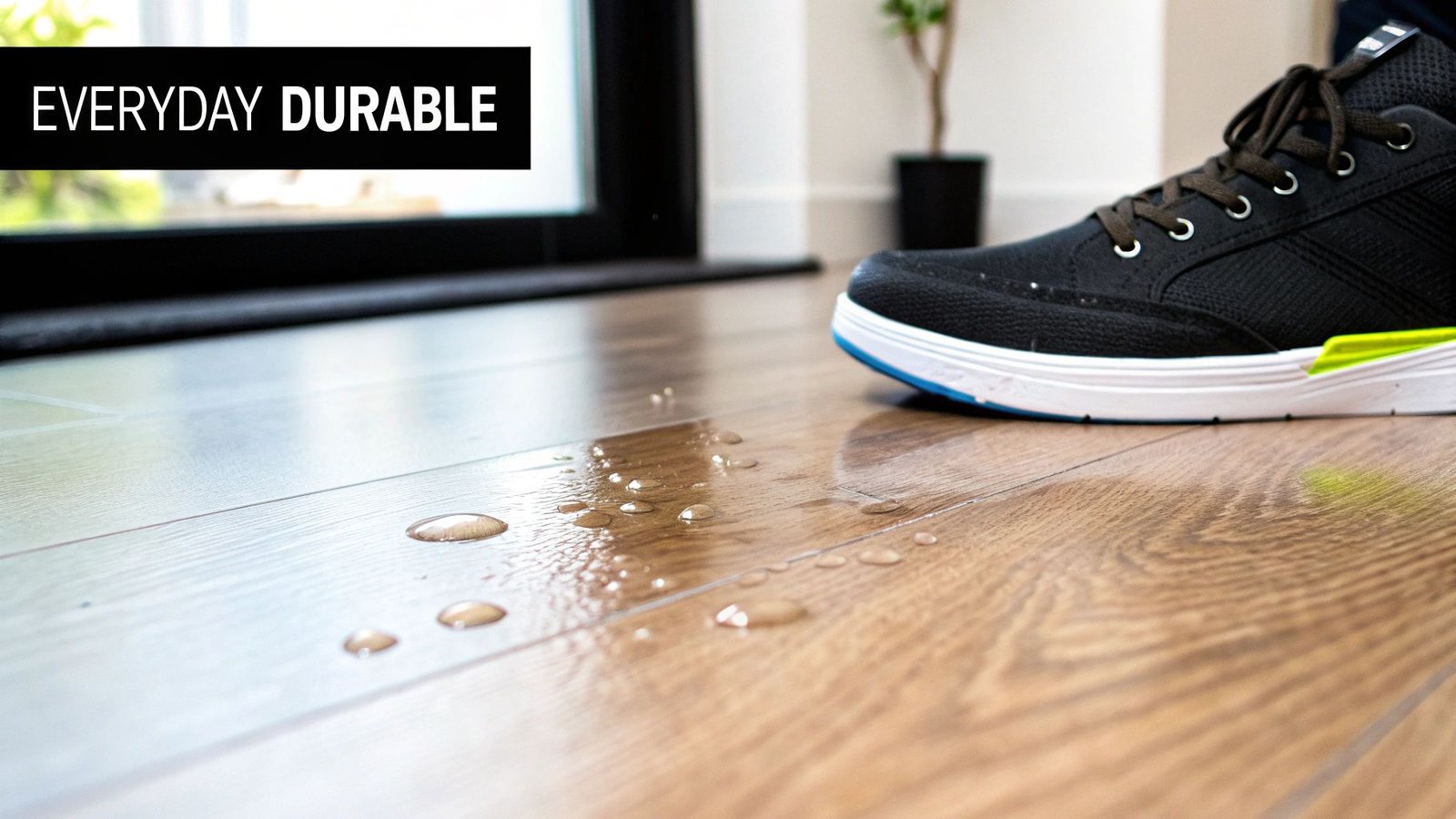
This is where the two paths really diverge. Luxury vinyl plank is 100% waterproof. We're not just talking "water-resistant"; its polymer materials are completely unaffected by moisture, from the top surface straight through to the core. Spills, pet messes, or a dishwasher leak won’t cause the planks to swell, buckle, or warp.
This makes LVP the hands-down winner for any room where water is part of the equation:
Solid hardwood, being a natural product, is the exact opposite. It's extremely vulnerable to water damage. Even a small puddle left too long can seep between the boards, causing them to cup, warp, and stain permanently. Here in the Carolinas, with our humid climate, this is a massive consideration for any homeowner.
Your floor is more than just a surface to walk on; it’s the foundation of your home's entire look and feel. When it comes to luxury vinyl plank versus hardwood, the aesthetic decision really boils down to one question: Are you drawn to the one-of-a-kind character of a natural material, or do you want the endless design flexibility that comes with an engineered product?
Hardwood brings authenticity you can’t fake — real grain, subtle variation, and a warmth that gives a home depth and soul. Every plank is slightly different, and that natural imperfection is exactly what makes a wood floor feel timeless rather than trendy.
Luxury vinyl plank takes a different approach. Instead of embracing variation, it gives you control. You can choose precise colors, consistent textures, and modern plank sizes that create a clean, intentional look — all while still capturing the essence of real wood.
Neither option is “better” aesthetically. The right choice is the one that feels like it belongs in your home, not something that was added later. When the flooring matches the architecture and flow of the space, it creates a cohesive look — and that’s when it feels truly finished.
Solid hardwood is all about authenticity. It’s real wood, through and through. Each plank tells its own story with unique grain patterns, knots, and subtle shifts in color. This organic character brings a warmth and depth to a space that simply can't be replicated.
It’s this natural, inherent uniqueness that has kept hardwood a hallmark of quality homes for centuries. It doesn't just chase trends—it establishes a benchmark for enduring elegance.
The real beauty of hardwood is in its imperfections. Those slight variations from board to board are a guarantee that your floor is genuinely unique, adding a layer of authenticity that enhances your entire home.
Whether you're after the classic, welcoming tones of oak or the deep, sophisticated look of walnut, a real wood floor makes an undeniable statement. It grounds your home with a sense of history and permanence, promising to look just as good in twenty years as it does the day it's installed.
Where hardwood shines with its natural beauty, luxury vinyl plank (LVP) excels with incredible design versatility. Honestly, the technology behind modern LVP is astonishing. It’s no longer the vinyl of the past; today’s planks can mimic the look and even the feel of real wood with stunning accuracy.
High-definition imaging captures the authentic patterns of different wood species, and advanced embossing techniques create textures that follow the visual grain. You can actually feel the subtle grooves and ridges under your feet, much like you would with real hardwood.
This technology opens the door to a much wider array of styles than what’s often practical or available with natural wood. For homeowners who have a very specific vision, LVP offers a world of possibilities.
This level of control means you can perfectly tailor your flooring to your vision, whether you’re aiming for a rustic farmhouse kitchen or a sleek, contemporary living room. To see just how realistic modern vinyl can be, explore the COREtec vinyl flooring collection. With LVP, that high-end designer look becomes truly accessible.
Let's get practical. Beyond how a floor looks and feels, you have to consider what it’s actually like to live with. The installation process and the daily maintenance routine for luxury vinyl plank and hardwood are worlds apart.
One is an old-world craft that takes time and a skilled hand. The other is a modern marvel of efficiency. How much disruption you can handle during installation and how much time you want to spend cleaning will steer you toward the right choice.
It’s this level of detail and craftsmanship that makes professional installation the only real option for solid hardwood flooring.
Luxury vinyl plank was engineered for speed. Most LVP uses a click-lock floating system, allowing installers to work efficiently with minimal disruption. For many homeowners, this is the deciding factor.
A professional crew can often complete an entire area in just a day or two. This efficiency is why our vinyl plank flooring installation in Greenville, SC is such a popular choice for busy families and rental properties.
Ultimately, LVP’s efficient installation and low maintenance can reduce overall costs by 30–50%, making it ideal for kid-friendly spaces and rentals, while hardwood remains the gold standard for premium, long-term home investments.
So, you've weighed the costs, durability, and aesthetics of luxury vinyl plank versus hardwood. The final decision really comes down to matching the material to your home’s specific rooms and, just as importantly, to your family's lifestyle.
It’s less about which floor is "best" overall and more about which one is perfect for you. Let’s synthesize all that information to help you make a confident, practical choice you’ll be happy with for years.
To cut through the noise, find the scenario that sounds most like your household. This will point you directly to the best solution for your home.
This decision tree gives you a quick visual on how installation priorities, like project speed and DIY-friendliness, play into the choice.
This is the simple version of your blog: pick the path that matches your rooms, your lifestyle, and your priorities. (Not “DIY vs pro” — this focuses on what actually matters: water, wear, value, and timeline.)
Kitchens, bathrooms, basements, laundry & mudrooms. LVP is 100% waterproof, so spills and leaks don’t warp the planks.
Choose LVPWear layer resists scuffs and stains. No panic over muddy paws, snack spills, or high-traffic paths.
Choose LVPFaster installs and lower installed cost in most cases — great for quick upgrades and larger areas.
Choose LVPHardwood is a premium feature buyers look for in Greenville/Asheville markets — it signals quality and timeless style.
Choose HardwoodScratches happen, but hardwood can be sanded and refinished to look brand new again (multiple times).
Choose HardwoodReal grain, real depth, natural variation — no two boards are identical. It’s the classic, high-end look.
Choose HardwoodRule of thumb: If water is part of the equation, LVP wins. If premium resale + renewability is the goal, hardwood wins.
Get a Free EstimatePracticality aside, your new floors need to look right in your home. The goal is a seamless look that complements your existing aesthetic, not a trendy choice that will feel dated in a few years.
The best new floors look like they were always part of the home's original design. You want to create a cohesive feel where everything flows together, avoiding that jarring "before and after" contrast between old and new finishes.
If you have a traditional home with classic hardwood floors already, dropping a modern, wide-plank LVP in the next room can create a serious style clash. A better move would be to either match the existing hardwood or, for a bathroom or kitchen, choose a timeless LVP in a stone or tile look.
On the flip side, LVP is fantastic for modern, open-concept homes. You can run the same plank from the front door, through the living room, and right into the kitchen without any transitions. This creates a clean, uniform look that makes the whole space feel bigger and more connected.
Ultimately, there's no single right answer in the luxury vinyl plank vs. hardwood debate—only what's right for you. By balancing your lifestyle demands with your design taste and budget, you can land on a decision you feel great about.
Ask yourself these final questions:
Answering these honestly will guide you to the material that not only looks stunning but also works effortlessly for your home and family.
Even after breaking down the details, a few questions always come up when homeowners are on the fence. We hear them all the time from folks right here in Greenville and Asheville. Let's tackle the big ones head-on so you can feel completely confident in your final choice.
Choosing the right floor is about more than just looks; it’s about finding what truly works for your family and your home.
Honestly, yes. The technology behind today's premium LVP is pretty incredible. It’s not the sheet vinyl you remember from decades ago. Using high-definition 3D printing and advanced texturing, manufacturers can now replicate the exact grain, knots, and subtle imperfections of natural wood. The best products even have an embossed texture you can feel.
Could an expert tell the difference if they got down on their hands and knees? Maybe. But to your friends and family, a high-quality LVP will look and feel just like the real thing. The only way to know for sure is to see it for yourself, in your own space, with your own lighting—which is exactly why we bring samples to your door.
For a busy house with four-legged friends and active kids, luxury vinyl plank is almost always the winner. Its secret is a tough-as-nails, commercial-grade wear layer on top. This protective shield is incredibly resistant to scratches from dog claws, scuffs from dragged toys, and the general chaos of a full house.
Even better, LVP is 100% waterproof. That means you don't have to panic about spilled drinks or pet accidents. Just wipe them up and move on, with no fear of the planks swelling, warping, or staining. For sheer peace of mind, it’s hard to beat.
When it comes to everyday durability in a family home, LVP’s one-two punch of scratch resistance and waterproof performance makes it the undisputed champion.
Absolutely. In a hot real estate market like ours, solid hardwood flooring is a major selling point. Buyers notice it, and they're often willing to pay more for it. You can typically expect a return on investment somewhere between 70% and 80%, which often translates to a direct increase in your home's resale value. If this is your long-term home or you're planning to sell soon, hardwood is a classic, sound investment.
That said, if you're updating a rental property, finishing a basement, or just need a beautiful floor without the premium price tag, LVP is an incredibly smart alternative. It delivers a high-end look and bulletproof performance for a fraction of the cost. The best choice really boils down to your property, your budget, and your goals.
Ready to see how these options look in your own home? The experts at Chuck’s Flooring are here to help. We offer free in-home consultations across the Greenville, Spartanburg, and Asheville areas to make your flooring decision simple and stress-free.
+1 (864) 564-7172
Chuckfloors@gmail.com
© 2026 Movely. All Rights Reserved.